After a Traumatic Decade, Greece Begins to See Light at the End of the Tunnel
Business surveys indicate activity, new orders, and employee recruitment at levels not seen in years, and economists forecast 2% growth in 2018
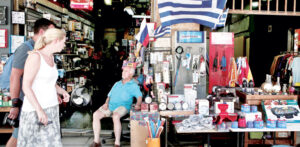
A souvenir shop in Athens. Small businesses provide most of the country’s employment / Photo: Reuters, Alkis Konstantinidis
As economic growth returns to Greece after a decade of crisis, companies that ignored it during that decade are returning as well. These days, the Spar supermarket chain has opened two new supermarkets on the islands of Crete and Skiathos, as a start to an expansion of 350 supermarkets it is planning in Greece.
Just two years ago, this Dutch chain abandoned Greece after its local partner went bankrupt. This was part of a wave of collapses in the country’s retail sector as household income plummeted by a third since the crisis began in 2009.
Greece’s situation looks rosier today. GDP rose by 1.4% last year, the first significant increase since 2007, led by a sharp rise in investment. Business surveys indicate activity, new orders, and employee recruitment at levels not seen in years. Economists forecast growth of approximately 2% this year.
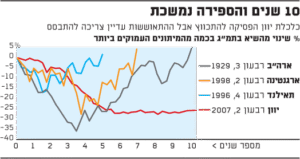
After an economic downturn that was among the longest and deepest in modern history, Greece is finally beginning to recover. If this continues, Greece’s recovery will conclude the final chapter of the eurozone crisis more than the planned end of the international aid package to Athens this coming summer.
“The worst is definitely behind us,” said Phoebus Karkitsios, CEO of Spar Hellas. Property prices have fallen to such an extent that it is worthwhile for investors to return, he added. “If the current stability in politics and society continues, there will be growth,” he said.
The battered country still has a long way to go to fully recover from a traumatic decade. The government budget collapse in 2009 led to a series of eurozone and International Monetary Fund bailouts. Strict fiscal discipline in exchange for emergency loans contributed to the economic free fall. Greek GDP plummeted by approximately 28%. Unemployment, which has already begun to decline, is still above 20%.
Greek politics remains completely polarized. The government has imposed exceptionally high taxes on households and businesses to meet budgetary targets set by international creditors.
Hopes for recovery have been dashed until now. Increased economic activity was recorded for a brief period in 2014, before falling victim to political instability, when the far-left Syriza party unsuccessfully attempted to cancel the bailout program that involved austerity policies.
But today the Syriza-led government is implementing the creditors’ program. Austerity has largely ended, and it weighs less heavily on the economy. Relations between Greece and its creditors, primarily Germany, are relatively quiet compared to previous years.
“No one is talking anymore about Grexit from the European Union,” said Tasos Anastasatos, chief economist at EFG Eurobank, one of Greece’s largest banks. “The question is whether we are talking only about a short-term response of the economy, or about a prolonged period of sustainable growth.”
Aegean Airlines, Greece’s largest airline, felt confident enough in March to order up to 42 new Airbus aircraft worth €4 billion ($4.9 billion). This is the largest investment by any Greek company since the crisis began.
“We examined this investment, and the gradual stabilization we feel here in the Greek economy, for more than a year,” said the company’s Vice Chairman, Eftychios Vassilakis. Risks to growth still exist, he said, including conflict in the eastern Mediterranean basin, where disputes between Greece and Turkey simmer on low heat. “But aside from this risk, I do not think we will return to the sharp decline of recent years.”
Tesla Also Shows Interest
Another example of renewed investor interest is the American electric car company Tesla, which has opened a small research and development center in Athens. This company has its own financial strains, but it says the choice of Athens reflects the combination of low wages in Greece and a skilled workforce. “Greece has strong talent in electric vehicle engineering and technological universities,” a Tesla spokesperson said.
Small businesses provide most of the country’s employment, and they are vital to growth. In central Athens, the rate of closed shops has fallen to 25% from a peak of 33% during the crisis, as consumer confidence begins to strengthen.
“This is the first time one can see calm and stability,” said Alex Laousis, manager of an online home goods store. He nearly left Greece in 2015, when the country was on the verge of bankruptcy. His annual sales have since increased by 150%. If this increase continues this year, he will consider doubling his number of employees. Politicians will need to help growth, because excessively high taxation cannot continue as it is.
The latest Greek labor market survey by Manpower found that intentions to hire new employees are the strongest in the past nine years. More than one in four Greek employers say they plan to hire employees in the current (second) quarter of the year. Only 5% of employers plan layoffs.
Georgios Stamatiadis, a 56-year-old marketing consultant with nearly 30 years of experience, found a new job at an internet company in February, after his private business was wiped out during the crisis.
“It was a prolonged descent down a hillside,” he says. “I got used to going to the supermarket with €10 and buying the food that would last the longest.” Now he can pay all his bills again. This summer he is planning his first vacation in three years.
Signs of Life in the Construction Sector
Even the ailing construction sector is showing signs of life. Ziris Tsatsikis’s engineering company is receiving far more orders for construction projects today—from businesses expanding their offices to several new residential projects.
“We are all still very cautious about the future,” says Tsatsikis. He notes that Greece still needs extensive reorganization, including in its inefficient bureaucracy.
After a decade in which the country lost a generation of college graduates who left it for work abroad, some young people are beginning to return home. In October, Natalia Nikolaidi, a 29-year-old nutritionist, returned to Athens from Azerbaijan. She says she knew income in Athens would be lower, but she felt there were more opportunities.
“I have many friends abroad and they also want to return soon. They hope this will be their last year abroad,” she says. “I think we are finally seeing a little light at the end of the tunnel.”