Mediterranean Opportunity: Turkish, Greek, and Cypriot Seeking Israeli Investor
Over the past decade, Israeli entrepreneurs have invested in real estate markets around the world but have skipped over neighboring countries. At a real estate conference to be held in Tel Aviv next week, entrepreneurs from Greece, Turkey, and Cyprus will attempt to compete for the Israeli investor’s attention. In conversation with Calcalist, they argue: The crisis in Greece and the conflict with Turkey should not be deterrents
Israeli real estate investors have reached every corner of the globe in recent years in search of properties with appreciation potential. They have stood out in real estate markets in countries such as the United States, Western and Eastern European nations, and have even demonstrated a notable presence in exotic countries like India, Brazil, or the Caribbean islands. Surprisingly, there has been no extensive Israeli activity in the real estate markets closest to Israel. There could be several reasons for this: the collapse of real estate prices in Greece, the strained relations between Israel and Turkey, the war between Turkey and Cyprus over maritime territorial control following Cyprus’s offshore drilling ventures, and general concern about what the future holds for the Middle East.
Next week, the international real estate conference TLVEXPO will open at the Tel Aviv Port, where senior executives from real estate companies worldwide will arrive, including entrepreneurs from Mediterranean basin countries: Greece, Turkey, and Cyprus. Amir Rochman, the conference director, explains that real estate professionals worldwide regard the Israeli investor as a bold investor, which is why they will come even from countries not at the top of the preference list among Israelis. “Turkey, for example, is a story in itself. We try to stay away from politics, and the truth is that beneath the leaders’ disputes, there is potential for growth and interesting projects,” he says.
“Greece is a country suffering economically and experiencing significant price declines; some experts say prices have reached bottom. There are opportunities to buy houses at ridiculous prices, such as a house on 4 dunams near the beach for €100,000,” he adds. Additional opportunities are found, according to him, on the island of Cyprus, where the market has maintained stability against the backdrop of market turmoil in Europe, yet has not entered the consciousness of the Israeli investor seeking to purchase a vacation property abroad. Israeli attitudes toward these markets have ranged from suspicion to complete apathy. However, precisely at this time when the government is pushing investors abroad and real estate prices refuse to show signs of breaking—these factors may lead them to explore what is happening with their Mediterranean neighbors.
Greece
Potential of Properties Far from Realization
Real estate prices in Greece have indeed been declining for the past three years, but anyone who tries to look for a bargain in sought-after locations such as the islands of Santorini, Crete or Mykonos will certainly be disappointed to discover properties that do not fall below 8,000 euros per square meter and can even climb to around 20,000 euros per square meter. Prices for these properties have indeed fallen by around 40% in the past three years, and local real estate professionals estimate that purchases in these areas will become profitable as soon as the market returns to normal; but many investors currently prefer to look for cheaper options in places that are under development, for higher improvement potential.
Idan Saroussi, an Israeli businessman who owns GRE, a real estate brokerage and consulting company in Greece, arrived in Greece from London three years ago in an attempt to find land to build a hotel. The search also included land in Israel, but he quickly realized that real estate prices in the country were already out of his reach. The search for cheap land brought him to the island of Lefkada in western Greece in the Ephesus region. The island is a five-hour drive from the Athens airport, and is even connected to the mainland by a bridge so that it can be reached by car. The island also attracts wealthy people because of its location on an ancient shipping route.
According to Saroussi, the island has many advantages, such as the Porto Katsiki beach, which is considered one of the most beautiful beaches in Europe, and even brought the Rothschild family to invest in a project in the area. Despite the many advantages of the area, real estate prices there are very low compared to prices on the better-known islands in Greece. “We sell old houses for prices ranging from 45 to 100 thousand euros and new houses for 150-200 thousand euros. There is also land here that is intended for building hotels for around 140-150 thousand euros per 2 dunams. These are prices that cannot be talked about in Israel at all. The place is in a development boom, but I believe that in a few years the prices here will be monstrous, and it will be impossible to obtain land at all,” he says.
Saroussi believes that prices are on the way up, but it is not certain that this will convince the skeptical Israeli investor in light of the news coming from the Greek economy. Konstantinos Rokophilos, owner of the construction company Paleros Development, will come to Israel with Saroussi in order to compete for the Israeli investor’s pocket. According to Rokophilos, the Greek real estate market currently consists of two markets: the local residential market, which is intended for Greek customers and is concentrated in large cities such as Athens; and the investor market, which mainly includes vacation apartments on the islands and in locations near the sea.
Rokophilos adds: “I would not recommend a foreign investor to purchase a property in Athens, for example, because prices may continue to fall and the return from renting an apartment to a Greek will be very low. On the other hand, in the vacation rental market, the rules of the game are different. It is true that in Mykonos or other islands, properties have also fallen by about 40%, but in the area where I am building in the Ionian Islands, the properties have not yet realized their potential and prices cannot fall,” he says.
Where do most buyers come from?
Rokophilos: “Mainly from Europe – Holland, England and Italy. There are also Americans and Scots. Most of them are preparing a retirement home for themselves that they can go to after age 65. Some of them are interested in renting it out during the year when they are not there, and this yields them a nice annual return of about 8%. But it is seasonal, it doesn’t work like that all year round.”
Why did you choose to come to Israel now?
“European markets are fluctuating and Israel is a good, new market. I also believe that this is a good opportunity for the Israeli investor.”
Do banks give mortgages to foreign investors?
“Not today. I believe that by the end of 2011, after the haircut that the Greek banks will undergo, they will have European management. There will be a new situation here, maybe Deutsche Bank will buy one of the Greek banks, who knows what will happen. In the current situation, the banks are unable to give mortgages, but it is possible that the new situation will actually be in the investors’ favor.”
What dangers should an Israeli investor beware of?
“The property needs to be thoroughly checked by a local lawyer. There have been cases where people bought 60 square meters and actually received a 50 square meter apartment. Today, this can no longer happen because there are new laws that protect the buyer, and an engineer who signs a fake certificate can be fined 100,000 euros and even lose his license.”
Turkey
Seeking Investors for Large Projects
The troubled relations between Israel and Turkey do not encourage a rush of real estate investors to the Turkish market, compounded by increased interest recently from residents of Arab countries seeking refuge in a country where 99.8% of the population is Muslim during the Arab Spring. However, beyond this, an objective examination of market indicators in Turkey points to a place with considerable investment opportunities.
For this reason, Tom Richard, marketing director at the real estate company Ripo Homes, decided to come to Israel and compete for the Israeli investor’s attention. Richard understands the implications of the diplomatic situation, and his decision to come to Israel was made after deliberation. He believes there are Israelis capable of seeing beyond the current situation. “Currently there is a misunderstanding between the prime ministers. Both have large egos, but I believe there will be a diplomatic solution to the situation,” he says. According to him, “I am not going to hide the situation when I arrive in Israel. It is clear to me that the average Israeli is afraid to buy a house in Turkey today and prefers a property in Italy or Spain, but Turkey is very interesting for large investors because it has great potential. Prices are still low, and I believe that in ten years they will double if not triple.”
The company headed by Richard offers its clients various properties, ranging from small apartments near the beach in Alanya at prices starting from €25,000, to villas at €150–180,000, as well as land for entrepreneurial construction on which he will focus most of his efforts when coming to Israel. His goal is to find large companies with strong financial backing interested in entering into partnership in one of the projects under consideration. One of them, for example, is located in the city of Belek in Antalya province, which has become a focal point for golfers worldwide and will even host the international golf championship in 2012. The project includes construction of 175 vacation units adjacent to a large golf club. Half of the project is already nearing occupancy, and the second half will proceed once a major investor is found.
According to Richard, the ancillary costs of purchasing a property in Turkey are minimal. The acquisition tax stands at approximately 3.3% of the property price. Beyond that, there are no additional taxes in the real estate sector. Additional expenses are in the area of municipal taxes and payments for bureaucratic procedures, such as transferring electricity and water accounts to the owner’s name. Furthermore, the mortgage market is open to foreign investors at interest rates of 5%–6%. Typically, the bank will appraise the property at approximately 80% of its actual market value, and therefore the mortgage value will reach 50%–60% of the property value, so these are still favorable terms in terms of financing. “I am coming without great expectations and look forward to dialogue with Israelis,” he says.
“Although the current government may make Israelis feel unwelcome in Turkey, one cannot ignore its tremendous successes over the past eight years, which have propelled the Turkish economy upward. In 2000 there were 5 million tourists per year here, and in 2010 there were already 30 million tourists per year. There is no doubt that Turkey is becoming a strong player in Europe, and an investor who understands this can also translate it into money.”
Cyprus
Buy a Property, Receive European Union Citizenship
Many Israeli businesses worldwide operate through Cyprus due to the lenient tax policy in the neighboring country, but regarding the real estate market, the number of projects developed there by Israelis can be counted on one hand. These include several purchasing groups organized for joint residential real estate acquisitions, and a project by B.S.R. company to establish a shopping mall in the capital Limassol. The vacation property market in Cyprus enjoyed a three-year real estate boom that lasted until 2008, primarily driven by British buyers seeking properties in the warm country. With the onset of the crisis, the number of British investors gradually declined and prices recorded corresponding decreases, but this does not constitute a dramatic price collapse. Andros Koroanos, CEO of the Cypriot real estate company Leptos Estate, will arrive in Israel next week to convince investors that this is a market with many advantages, especially for Israelis.
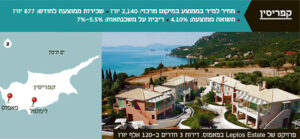
Besides proximity to Israel (45 minutes by flight), pleasant weather, market stability, and Cyprus being one of the safest countries in the world, it has another significant advantage: the Cypriot government, which encourages real estate investments in the country, allows anyone purchasing a property priced over €300,000 to receive permanent citizenship. After five years, the property holder can also belong to the European Union. “There is no need to explain how much this incentive appeals to citizens of many countries worldwide. You can buy a house in Cyprus, and if tomorrow there are problems in Israel, you have the option to send your family to a safe place,” says Koroanos.
According to him, “This is a country that is very easy to navigate in terms of language. Everything here is written in English as well—signs, bank accounts, hospital forms, and so on. Furthermore, prices here have risen consistently over the past 20 years, and buyers see that investment in Cyprus returns the money.” The acquisition tax, according to Koroanos, stands at 3%–5% of the property price. Prices range from properties at prices much cheaper than apartment prices in Israel: a 3-room apartment in Paphos will start at €120,000, a 4-room apartment at €200,000. However, there are properties whose prices reach sky-high levels, such as in the company’s project on the promenade in Limassol where prices reach up to approximately €5 million.